
Does It Matter What Philosophers Think? Expertise and the PhilPapers Survey on God
On the Significance (Or Lack Thereof) of a Widely Cited Statistic

Introduction
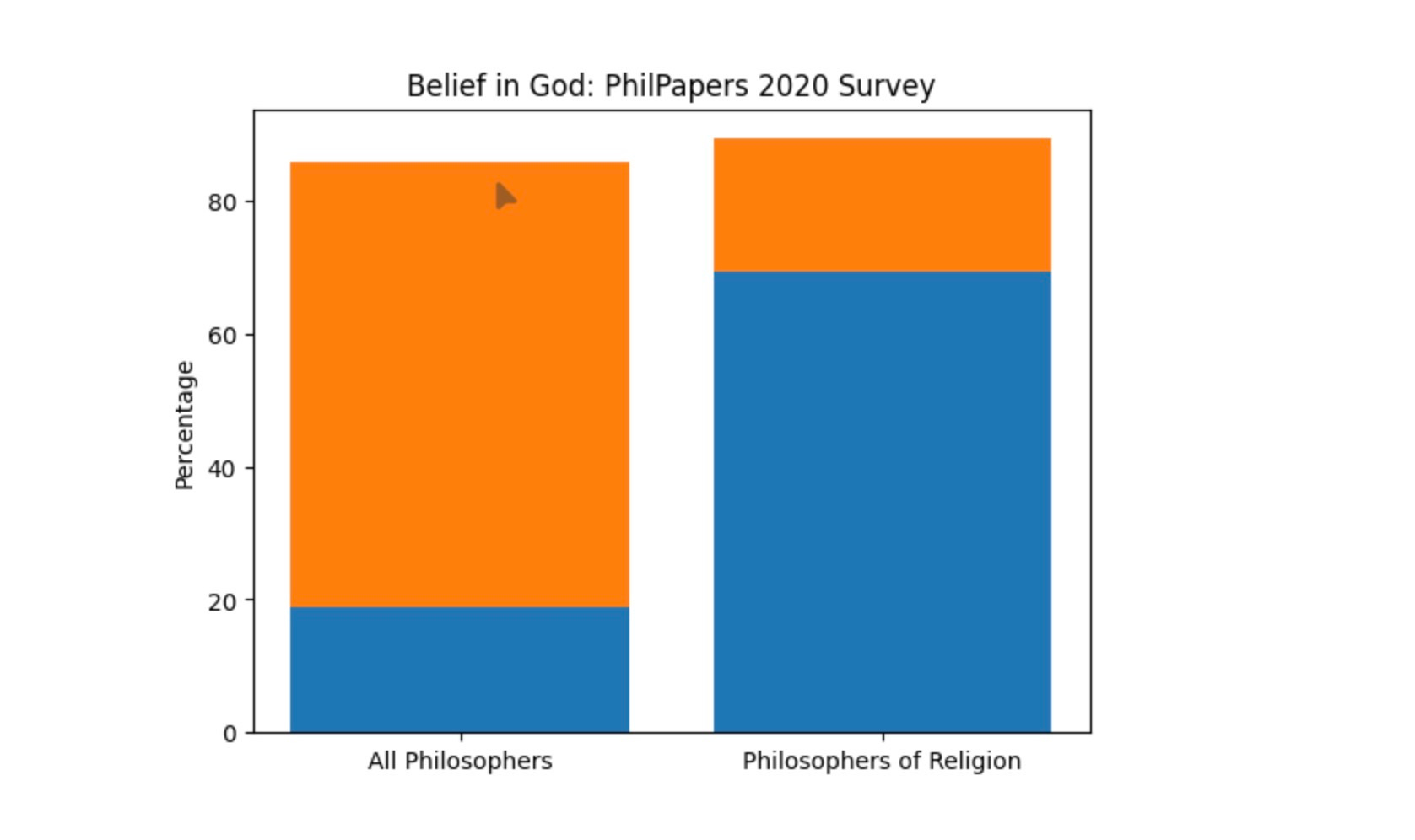
In recent years, a particular statistic has circulated widely in online discussions about the case for theism: according to the 2020 PhilPapers Survey by David Bourget and David Chalmers, a substantial majority of philosophers accept or lean toward atheism. Many have thought the implication is straightforward — namely, that if those who have devoted their careers to philosophical inquiry overwhelmingly reject theism, as the survey suggests (with 66.95% of respondents leaning toward or accepting atheism), then the intellectual case for belief in God must be weak.
However, while tempting, that inference is too quick. Here I argue that the PhilPapers result does not bear the weight often placed on it. I begin by explaining why arguments from authority are generally suspect in philosophy. Second, I argue that the relevant expert class, if there is one, is not philosophers at large but philosophers of religion — among whom the distribution of views is markedly different. Finally, I show that the contemporary philosophical profession is historically unrepresentative and shaped by ongoing selection effects. Even if each of these considerations is individually inconclusive, taken together they substantially undercut the inference from majority opinion to an epistemic verdict. Once these considerations are in view, the survey provides little reason to think that philosophical reflection favors atheism.
1. The Limits of Philosophical Consensus
In some domains, expert consensus plausibly indicates truth (or at least what it is rational to believe).1 When physicists converge on a theory, or when medical researchers agree on a treatment, it is usually reasonable to defer. Philosophy, however, is not like this. It does not exhibit the kind of convergence characteristic of the mature sciences. Indeed, with respect to many central questions in philosophy, deep and persistent disagreement remains — even among highly competent practitioners.
The question of God’s existence belongs broadly in this class. While the PhilPapers survey is often taken to show a kind of convergence on atheism, it is not clear that this reflects the sort of robust, truth-tracking consensus found in the mature sciences.
Philosophical agreement is typically more fragile and more sensitive to background assumptions, disciplinary trends, and patterns of specialization. Even where a majority view emerges, it does not follow that the underlying question has been settled in the way that scientific consensus often settles empirical questions.
As David Bourget and David Chalmers themselves note, such surveys are best understood as sociological data rather than as indicators of philosophical truth (Bourget & Chalmers 2023).
2. Who Counts as a Philosopher?
Even setting that aside, the PhilPapers result invites misunderstanding because of the way it is reported. When people hear that “most philosophers are atheists,” they often imagine a group of seasoned experts who have carefully surveyed the full range of arguments and arrived at a considered verdict. But this is not what the category captures.
The survey samples the contemporary philosophical community broadly, including graduate students, early-career academics, and philosophers working in areas far removed from philosophy of religion. This reflects how the discipline is structured in contemporary academia. Like most research fields, philosophy is now highly specialized. A philosopher’s expertise is typically confined to a narrow range of topics — often highly technical and far removed from the God question. A leading figure in formal epistemology or philosophy of language, for example, may have had little or no sustained engagement with the arguments of natural theology.
The result is that the category “philosophers” is epistemically heterogeneous in a way that is directly relevant to how we should interpret the PhilPapers survey data. Being an accomplished philosopher does not, by itself, make one an expert on the existence of God.
3. The Relevant Reference Class
Which experts, if any, are relevant to the God question? Quite clearly, the answer is philosophers of religion. These are the people who have studied the arguments of natural theology in the greatest depth. And here the pattern looks very different: among this class of philosophers, a clear majority (69.5%) accept or lean toward theism.
This does not, of course, settle the matter. But it does block a common and rhetorically powerful inference. One cannot simply move from “most philosophers are atheists” to “the experts have spoken.” The relevant expert class does not exhibit that pattern. This immediately raises a familiar objection — namely, that philosophers of religion are a non-random subset of the profession.
4. Selection Effects?
Of course, it might be objected that philosophers of religion are more likely to be theists to begin with — that is why they chose the field. There is surely something to this, though there certainly are philosophers who become theists through the study of natural theology (Edward Feser and Antony Flew being two prominent examples — myself being a much less prominent one).
But if selection effects are doing significant work here, then the distribution of views among philosophers at large cannot be straightforwardly interpreted as tracking the strength of the arguments. At the very least, the data would admit of multiple competing explanations.
5. The Historical Perspective
The contemporary philosophical profession is not historically representative. If we widen the reference class beyond contemporary professional philosophers, the idea that philosophical reflection naturally tends toward atheism becomes much less plausible.
For much of the history of philosophy, theism (in various forms) was not merely taken seriously but often endorsed. From Plato and Aristotle to Plotinus, Augustine of Hippo, Anselm of Canterbury, Thomas Aquinas, John Duns Scotus, René Descartes, and Gottfried Wilhelm Leibniz, philosophical reflection did not tend to converge on atheism. Explicit philosophical atheism was comparatively uncommon in earlier periods. As the Stanford Encyclopedia of Philosophy notes, philosophical engagement with religion has long been intertwined with realist commitments about the divine (SEP, “Philosophy of Religion”).
A more plausible explanation of the current situation is that it is the product of an intellectual culture that secularized under the combined influence of changing material conditions — such as affluence and consumerism — and a series of anti-theistic intellectual movements that, in different ways, either rejected or sidelined traditional metaphysics generally, and the “God question” in particular. These include Marxism and its myriad offshoots, Freudianism, physicalism, scientism, logical positivism, Sartrean existentialism, and post-structuralism. These movements did not rise to prominence by decisively refuting classical metaphysics and natural theology, but rather through a combination of presumption and institutional influence which, over time, instigated some profound shifts in what was treated as intellectually “respectable”.
The cumulative effect was to redirect philosophical attention away from traditional theological questions. Even where these movements are now widely regarded as inadequate in their stronger forms, their institutional and pedagogical effects persist. The result is a profession whose current distribution of views may tell us at least as much about the intellectual and cultural environment out of which it emerged — and the kinds of students, interests, and assumptions that environment tends to select for — as it does about the underlying merits of theism and atheism.
6. Selection Effects, Revisited
In view of the above, let us now return to the role of selection effects, at the level of the discipline as a whole. Even if we grant that historical and intellectual forces helped to secularize philosophy, there are reasons to think that the current distribution of views is not merely the residue of past philosophical discoveries or developments.
If philosophy — especially as encountered at the undergraduate level — is widely (no, not universally, but widely) perceived as hostile to religious belief, then this will predictably influence who is drawn to the field. Students who already lean toward atheism or agnosticism will be more likely to pursue philosophy further, while those with strong theistic commitments may be less inclined to enter or remain in the discipline. This is not because they are incapable of engaging with philosophical argument, but because the field presents itself, in practice, as inhospitable to their views.
Over time, this dynamic generates a feedback loop. A profession that is disproportionately secular will tend to frame questions, design curricula, and set research agendas in ways that reflect its prevailing assumptions. Those assumptions, in turn, shape the experience of students encountering philosophy for the first time, reinforcing the perception that serious philosophical inquiry points away from theism. The result is a process of selection and reinforcement, rather than a straightforward convergence on the truth.
This need not involve bad faith or deliberate exclusion. It is a familiar sociological phenomenon — academic fields tend to reproduce the dispositions and assumptions of those most inclined to enter them. But if something like this dynamic is at work in philosophy, then the distribution of views within the profession cannot be taken as a neutral indicator of where philosophical reflection, pursued under ideal conditions, would lead. It may instead reflect, at least in part, who remains in the room.
Conclusion
The PhilPapers Survey is often treated as if it provides a kind of empirical verdict on the rational status of theism. It does not. At most, it tells us something about the distribution of views within a particular academic community at a particular time in history.
Once we attend to the heterogeneity of that community, the importance of specialization, the divergence between generalists and relevant experts, the historical contingency of the contemporary sample, and the role of ongoing selection effects, the evidential force of the survey is substantially weakened. The data have rhetorical appeal. But they do not show that philosophical reflection favors atheism.
What they show, more modestly and more plausibly, is that the question very much remains a live one.
References
Bourget, David, and David J. Chalmers. “Philosophers on Philosophy: The 2020 PhilPapers Survey.” Philosophical Impressions (2023).
https://journals.publishing.umich.edu/phimp/article/id/2109/
PhilPapers Survey 2020. https://survey2020.philpeople.org/
PhilPapers Survey 2020 — Philosophy of Religion (AOS) Results.
https://survey2020.philpeople.org/survey/results/4842?aos=22
Stanford Encyclopedia of Philosophy. “Philosophy of Religion.” Edited by Edward N. Zalta.
https://plato.stanford.edu/entries/philosophy-religion/
Feser, Edward. “The Road from Atheism.” edwardfeser.blogspot.com, July 2012.
http://edwardfeser.blogspot.com/2012/07/road-from-atheism.html
Flew, Antony. There Is a God: How the World’s Most Notorious Atheist Changed His Mind. New York: HarperOne, 2007.
For an extended reflection on arguments from authority, see here:

As a scientist, I appreciate your rigorous look at the 'Expertise' factor. The fact that specialists in Philosophy of Religion—those most familiar with the actual arguments—lean toward theism (69.5%) completely flips the narrative. It’s a classic case of why we must look at the 'AOS' (Area of Specialization) rather than just the generalist consensus. A brilliant breakdown of selection effects!
Great piece--thanks for posting it. To build on your point about the likelihood of first exposure to philosophy being hostile to the rationality of religious belief: it is rather shocking how bad/error-ridden the presentations of classical theistic arguments are in mainstream philosophy textbooks. For many (if not most) university students, these textbooks will be their only sustained exposure to the philosophy of religion. Something to consider.